




What Happens When More Women Lead? Changing Systems and Sustaining the Work
Hey Well Woman!
What happens when more women step into positions of leadership?
These breakthroughs are worth celebrating, but representation alone doesn't guarantee meaningful change.
The bigger question is what we do with the possibilities this moment creates, and how we turn political progress into changes that improve everyday life.
Here in New Mexico, Deb Haaland's election as governor, alongside Lieutenant Governor-elect Stephanie Garcia Richard, marks a historic moment. Nationally, 18 women will serve as governors in 2027, setting a new record, according to the Center for American Women and Politics at Rutgers.
These milestones matter. But leadership is about more than who holds a position. It's also about the decisions they make, the systems they influence, whose needs are considered, and whether people have a meaningful role in shaping the outcomes.
Throughout my career, I've approached this work from two connected directions: challenging the status quo to create meaningful change in the systems around us and helping women sustain the personal and collective capacity to keep that work moving.
1. Challenging the Systems That Shape Our Everyday Lives
My work in public affairs and policy has brought me into conversations about the systems that shape people's daily experiences, including housing, healthcare, and workplace issues.
I founded Family Friendly New Mexico to support businesses in creating family-friendly workplaces. Through the Family Friendly Business Award, we work with employers on policies and practices that make it more possible for people to work and care for their families.
This is one example of bringing feminist change into mainstream institutions. A workplace policy might seem like an administrative decision, but it can determine whether a parent has time to take a child to an appointment, whether someone can remain employed while caring for a family member, or whether caregiving responsibilities can be shared.
The same is true of decisions made in government, schools, and other institutions. They affect whether people can afford housing near their jobs and support networks, access healthcare, find dependable care, and have time for their own lives.
Feminist economics helps us understand why these everyday experiences are connected to larger systems. It asks us to look at all the work and resources that sustain our lives, including the care and coordination that happen without a paycheck.
Who does that work?
Who controls their time?
Who bears the cost when a workplace, public service, or policy assumes someone will always be available?
These are not simply personal questions. They are questions about policy, resources, power, and whose needs count.
Meaningful systems change requires people with different experiences, interests, and areas of influence to come together.
In my work, I bring businesses, government, advocates, nonprofits, workers, and communities into conversations about what we can accomplish together. I also ask who gets to shape the agenda, whose needs might be overlooked, and whether people have a real opportunity to influence decisions.
The goal isn't just to put more women in positions of leadership. It's to change the conditions that shape our lives.
2. Sustaining the Work: Supporting Women Personally and Collectively
Changing systems takes time and is only half of the work. It requires people to keep showing up, building relationships, navigating disagreement, and working through setbacks. So, we also need to ask: What helps women sustain this work without losing themselves in the process?
This is where my work through Well Woman Life, including my coaching and the Well Woman Life Framework, comes in.
The Well Woman Life Framework explores the relationship between our internal practices, what we do within ourselves, and our external supports, the people, time, and structures around us that help us keep going.
Its four quadrants/stages, Awareness (Listen), Intuition (Linger), Action (Leap), and Acceptance (Love), help us recognize where we are and consider what we need. Awareness and Acceptance are internal practices, while Intuition and Action are external supports.
These quadrants form a cycle, not a straight line.
We return to them again and again as our circumstances, priorities, and relationship with change evolve.
✨ Awareness (Listen): Notice What You Have Started to Carry as Normal
Reactive | Internal practice
When we are constantly responding to everyone else's needs, we can lose touch with our own. Awareness begins when we stop and listen.
Many of us have become very good at anticipating needs and keeping things running. Then we are exhausted, and when we're exhausted, we ask ourselves how to become more organized.
When we need help, we wonder whether we should have been able to manage. When we want something for ourselves, we start calculating how everyone else might feel about it. Noticing that pattern is the first step.
Ask yourself: Can I recognize what I need? What am I carrying that I have come to see as normal?
✨ Intuition (Linger): Make Room to Hear What You Want
Passive | External support
Sometimes we need time and space to hear what we feel before deciding what to do. Intuition asks us to linger, and Linger reminds us that we don't have to create that space alone.
External support can look like time, money, dependable care, supportive relationships, and working conditions that allow us to act on our choices. These resources give us room to reflect, trust our judgment, and imagine what else might be possible.
I see the importance of these relationships at Well Woman Drinks. When women have the opportunity to connect beyond professional introductions, they can find encouragement, practical support, and a sense of belonging. Those connections can also become the beginning of people working together to change something.
Ask yourself: Do I have the time and the people who help me hear what I want?
✨ Action (Leap): Begin Together, With One Practical Support and One Change
Active | External support
Action is where awareness becomes a boundary, an honest conversation, or a request for help. It is also where we can work with others to change the conditions affecting our lives.
In this episode, I invite you to think about a small group you're already connected to: friends, colleagues, neighbors, or people in an organization. Ask one another what's making everyday life unnecessarily hard. Listen for something you share, such as caring for older relatives, the gap between school and working hours, housing costs, or isolation.
Then choose one practical way to support one another now and one institutional change to pursue together.
Parents might create a dependable school-pickup arrangement while working with the school district to expand after-school care. Colleagues might prepare a proposal for more predictable scheduling. People supporting older relatives might share practical help while advocating for better local services.
Decide who will do what, share the coordination, make the time involved visible, and set a date to come back and ask what has changed.
The relationships can help sustain the effort. The institutional change can reach people beyond the group.
Ask yourself: What is one practical way I can support someone now, and one change we could pursue together?
✨ Acceptance (Love): Let Your Needs Matter, Too
Receptive | Internal practice
Acceptance invites us to acknowledge our needs, circumstances, and limitations without judging ourselves for having them. It doesn't mean accepting unfair conditions or giving up on change. It means recognizing where we are and what we need.
Our circumstances are different. Access to money, time, dependable care, supportive relationships, and flexible working conditions can shape what is possible for each of us.
My feminist vision is a better everyday life for everyone. Women need care, safety, economic security, and authority over our own lives. Children need adults with the time and capacity to care for them. Older people need support and dignity. Men need room to care for others, receive care, and share responsibility. Everyone's needs matter.
I've also been thinking about building small matriarchal communities where care is valued, women's knowledge and authority are respected, and responsibility is shared. I wonder what it would look like if people could ask for help and still have an equal voice, or if the person who usually coordinates everything could step back and receive support.
Ask yourself: Can I let my needs matter, and let someone support me?
The cycle continues. After taking action and making room for our needs, we may notice something new. We return to Awareness, listen again, and find the support we need for what comes next.
Why Changing Systems and Sustaining the Work Belong Together
We cannot separate the work of changing systems from the work of sustaining the people who make change possible.
We need institutions that value care, provide economic security, support families, and give people more control over their time.
We also need the internal practices, relationships, and external support that allow us to participate in creating those changes.
This is why I see personal growth and institutional change as connected, rather than competing priorities.
We can build self-trust, recognize our needs, and learn to ask for help. But we also need dependable care, fair workplace policies, safe housing, access to healthcare, and the resources that make those choices possible.
Community is part of that support, too. At my monthly Well Woman Drinks, I see what can begin when women feel they belong, speak honestly, and have the opportunity to know one another beyond a professional introduction. A relationship can become a source of practical support. It can also become the beginning of people working together to change something.
Ease becomes more possible when we have dependable support and reasonable expectations. Joy needs room in our lives. Impact requires opportunities to participate and some capacity to keep showing up.
These possibilities are shaped by our relationships, workplaces, public institutions, and the resources available to us. We can influence them.
What Could We Change Together by 2028?
As we celebrate more women entering positions of leadership, I want us to keep asking what those breakthroughs can make possible.
By the next presidential election in 2028, could more people count on predictable work schedules?
Could more families find dependable care?
Could more people afford a home near their work and the people who support them?
What decisions would move us toward those outcomes?
Who has the authority to make them? And how can we participate?
We can bring these questions into conversations with elected officials, employers, schools, organizations, and our own communities.
We can look at the decisions and practices that make everyday life harder than it needs to be and consider what we might change together.
And I want us to remember that leadership doesn't always come with a title or a platform. It can begin with speaking up when something isn't right, making space for another woman's voice, encouraging someone to take a step she might not have considered, or bringing people together around an idea for a better way of doing things. Each of us has something to contribute.
This work is a long game. Some days it will feel like a wave, and other days it will feel like a slog. There will be victories and setbacks. We won't always see the results right away. But we can keep going by recognizing that we're part of something larger than ourselves and by caring for the women alongside us in the work.
We each have a part to play, whether we're leading, creating change in our communities, supporting another woman, or encouraging someone who's finding her own way.
The work doesn't begin or end with an election. It continues through the choices we make, the systems we question, the communities we build, and the opportunities we create for one another. Meaningful change can start with one person deciding that things can be different.
As you think about the work you want to be part of, consider these questions:
We don't need to have all the answers before we begin. We can start with a conversation, a shared concern, or one practical way to support someone around us.
Changing systems takes collective effort.
Sustaining that work takes internal practices, external support, care, and connection.
We need both to create meaningful change that lasts.
Take or Retake the Well Woman Quiz to explore where you are in your own cycle of change and what support might serve you now: wellwomanlife.com/quiz.
Below is the full transcript of the episode, lightly edited for clarity.
Women in Leadership
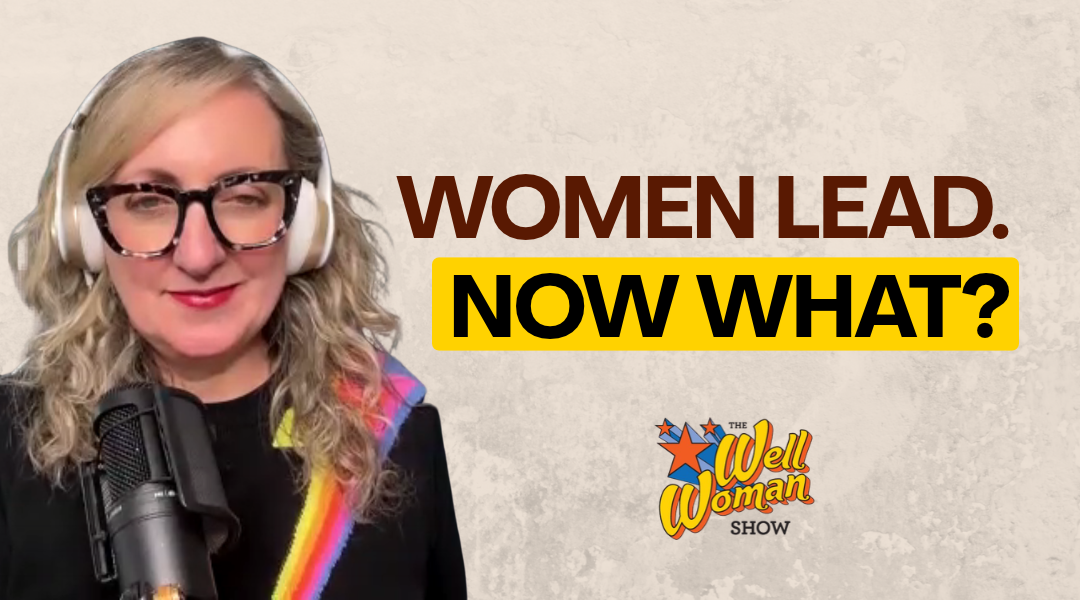
Welcome back to the Well Woman Show, where we support you to lead with ease, live with joy, and create meaningful impact on your own terms. I'm your host, Giovanna Rossi.
Today, it's just you and me. Since the elections, I've been thinking about the women stepping into leadership and what we can do with the possibilities that this moment creates.
So here in New Mexico, Deb Haaland became the first Native American woman to serve as governor in the United States. Alongside Lieutenant Governor-elect Stephanie Garcia Richards, she's part of the first all-women of color gubernatorial ticket elected in this country.
I've had the honor of interviewing Governor-elect Haaland twice on this show. Watching somebody whose leadership I've had the opportunity to explore in conversation take this next step feels especially meaningful.
And nationally, according to the Center for American Women in Politics at Rutgers, 18 women will serve as governors in 2027. That's a record.
There's joy in seeing women reach positions of authority from which they've historically been excluded. There's something really powerful about a girl seeing a woman lead and being able to imagine herself there.
So, I really want us to take that in. And I want to recognize the people who made these campaigns possible. The candidates, the staff, the volunteers, the families, the funders. And the people who kept showing up, including in races that didn't end in victory.
Feminist Policy and Institutional Change
Then I want to ask a question. What would it take for these breakthroughs to make everyday life better?
By the next presidential election in 2028, what could we have changed together?
This is a question I've been approaching from different directions throughout my career.
I work in public affairs and policy, and I bring people together around housing, healthcare, and workplace issues. I founded Family Friendly New Mexico, a non-profit organization that supports businesses to implement family-friendly workplaces. I've coached women, created spaces for connection through Well Woman Drinks, and explored women's lives and leadership through this show.
Recently, I found a way to describe what connects that work.
Throughout my career, I've worked to advance feminist change inside mainstream institutions and systems. I bring questions about care, power, whose work counts. And whose needs matter, into places where decisions are made.
And through the Well Woman Life framework, I help women connect those questions to what's happening in their own lives.
Because the decisions made in a legislative committee, a company meeting, or a school district office eventually becomes someone's everyday experience. They affect whether you can take your mother to an appointment, whether you can afford a job that you want, whether you can afford to live near your job. Whether your child has somewhere safe to go after school. And whether you have any time left for yourself.
Feminist Economics and Care Work
Let's take an ordinary situation as an example.
Your work schedule changes with very little notice. You're expected to adjust. But your child's school hours haven't changed at all. The person who helps with pickup has their own job. The after-school program closes at a particular time. So, you start calling people, rearranging, asking for favors, perhaps losing income, perhaps paying more for care than you can comfortably afford.
From the employer's perspective, a staffing adjustment has been made. In your life, that decision has created hours of additional work. Someone has to absorb that disruption.
Feminist economics gives us tools to examine what happens here. It asks us to look at all the work and resources that sustain our lives, including the care and coordination that happen without a paycheck.
Who does that work? Who has control over their time? Who bears the cost when a workplace, a public service, or a policy assumes that someone will always be available?
Those questions can help explain why something that feels deeply personal Has a real structural cause.
You may be incredibly resourceful. You may find a way to make the schedule work. And we can still ask why the arrangement requires so much of you.
This is part of what I mean when I talk about feminism. It helps us examine how expectations and institutions shape our choices.
Many women have learned to be accommodating, anticipate needs, and keep things running. We can become very good at it. We have become very good at it.
We may also come to measure our worth by how little we need and how much we can carry.
Then, we're exhausted. And when we're exhausted, we ask ourselves how to become more organized.
When we need help, we wonder whether we should have been able to manage. When we want something for ourselves, we start calculating how everyone else might feel about it.
These experiences differ among women. Money, race, ability, geography, immigration status, and family circumstances affect the choices available to us.
That matters when we talk about solutions.
A woman with savings and a flexible job has options that someone working in an unpredictable hourly schedule may struggle to access.
We have to ask whose circumstances a proposed solution actually fits.
Well Woman Life Framework (Women's Support Strategies)
In my Well Woman Life Framework, I look at both inner resources and external support.
Can I trust my own judgment? Can I recognize what I need? Can I respond thoughtfully under pressure, set a boundary, or ask for help?
And what support do I have around me? Do I have time, money, dependable care, supportive relationships, and working conditions that allow me to act on those choices?
We can strengthen our inner resources while working to change the conditions around us.
And that really is what I have been working on for so long.
And that's the connection I really want us to keep making.
If a woman is overwhelmed because she's carrying an unreasonable workload, helping her recognize her needs matter. So does changing how that workload is distributed.
If she's afraid to speak in a meeting, building confidence may help. We should also examine what happens in that workplace when women disagree.
Personal growth and institutional change can support each other.
Family Friendly New Mexico is one place where I've put that belief into practice. Through the Family Friendly Business Award, we work with employers on the policies and practices that shape people's ability to work and care for their families.
An employer has authority to change an expectation, a practice, or a policy that affects many people. That decision can give a parent more room to manage a school appointment. It can help someone remain employed while caring for a family member, it can make it more possible for people to share caregiving responsibilities.
This is why I work with institutions, including industry.
Businesses make decisions that have enormous consequences for our lives. Government, advocates, nonprofits, workers, and communities also bring knowledge, resources, and authority.
My work involves bringing people together who have different interests and different politics.
I ask, what we can accomplish together? I also ask, who gets to shape the agenda, and whose needs might be overlooked?
Participation matters when people can influence what happens, and working together requires the willingness to address how power is used, including when that conversation is uncomfortable.
These are commitments I bring into my consulting. They're also questions I have to keep asking of my own choices.
When I talk about a feminist vision, I'm imagining a better, everyday life for everyone. Everyone needs care at some point. Women need care, safety, economic security, and authority over our own bodies and lives.
We need our work to be valued, responsibilities to be shared, and time for rest, pleasure, ambition, and relationships.
Our needs matter in their own right.
Children need adults with time and capacity to care for them.
Older people need support and dignity.
Men need room to care for others, receive care, ask for help, and build relationships in which responsibility is shared.
We all benefit from having somewhere safe to live, access to healthcare, and some control over our time. And we have to pay attention to who continues to face the greatest barriers.
That's how everyone becomes a commitment we can act on.
Matriarchal Communities and Governance
So back to the election. Women entering public office creates opportunities. What those opportunities produce, depends on decisions, resources, public participation, and sustained work. I want to see us connect the celebration to specific expectations.
By 2028, could more people count on a work schedule that they can plan their lives around?
Could more families find dependable care?
Could more people afford a home near the places they work and the people who support them?
What decisions would move us toward those outcomes?
Who has the authority to make them?
And how can we participate?
We can ask those questions on elected officials. We can bring them into our workplaces, schools, organizations, and neighborhoods. We have two years in which to build relationships, pursue changes, and see what improves.
I've been thinking about building small matriarchal communities inspired by conversations others are bringing forward.
Wanwanluve on Instagram has been talking about this, as has Maya West, through her matriarch makeover. I've had the opportunity to interview Maya on this show, and I want to acknowledge how these ideas are informing my own thinking.
The question I'm exploring is how we put them into practice in the communities and institutions we're already part of.
I'm imagining communities where care is valued, women's knowledge and authority are respected, responsibility is shared, and everyone's needs matter.
What would that look like day-to-day? Who decides? Who does the organizing? Who manages the money?
Can people ask for help and still have an equal voice?
Can the person who usually coordinates everything step back and receive support?
Those questions matter because a community builds around care needs people, time, and resources to sustain it.
At my monthly event, Well Woman Drinks, I see how much can begin when women feel they belong, can speak honestly, and have an opportunity to know one another beyond a professional introduction.
A relationship can be a source of practical support. It can also become the beginning of people working together to change something.
That's a possibility I want to explore further.
Community Support Systems
So, here's the invitation to begin.
Think about a small group you're already connected to, a few friends, colleagues, neighbors, or people in an organization.
Ask one another, what is making everyday life unnecessarily hard.
Listen for something you share. Perhaps it's caring for older relatives, perhaps it's the gap between school hours and working hours. Perhaps it's housing costs or isolation.
Then choose one practical way to support each other now. And choose an institutional change to pursue together.
For example, a group of parents might establish a dependable arrangement for school pickup while working with the school district to expand after-school care.
Colleagues might help one another prepare a proposal for a more predictable scheduling policy.
People supporting older relatives might share information and practical help while advocating for better local services.
Decide who will do what, share the coordination, make the time involved visible.
And set a date to come back and ask what has changed.
The relationships can help sustain the effort. The institutional change can reach people beyond the group.
I think about ease, joy, and impact in this context.
Ease becomes more possible when we have dependable support and reasonable expectations.
Joy needs room in our lives. Time to enjoy the people we love, follow a curiosity, or do something simply because we want to.
Impact requires opportunities to participate and some capacity to keep showing up.
Those possibilities are shaped by our relationships, our workplaces, our public institutions, and the resources available to us. We can influence them.
And that's the work I want us to keep exploring here, understanding how systems shape our lives, recognizing where we have influence, and building the support to act together.
So, I'll leave you with 3 questions.
What are you carrying that could become a shared responsibility?
Where could you help change a decision, a practice, or a policy?
And what would you like to help make easier for people by 2028?
Take those questions into a conversation with someone you trust. I'd love to hear what you begin.
Thank you for being here, for listening, and for being part of this community. I'm Giovanna Rossi, and this is the Well Woman Show.
Until next time, have a super powerful week.