




Women Supporting Women: What Gloria Steinem Taught Us About Mothering Each Other
Hey Well Woman!
What helps us believe that our voices matter?
That our ideas are worth sharing, that we deserve to take up space, and that we are lovable simply because we exist?
Gloria Steinem once put words to something many women recognize in their own lives:
“How we know we have something to say is that we were listened to as a child. How we know we are lovable is that we were loved as a child. If those things were absent, it takes a long time to make up for them.” - Gloria Steinem
I keep coming back to these words because they remind me how deeply our early experiences can shape the way we see ourselves.
When we grow up feeling heard and valued, we learn that our voices matter. When those experiences are missing, developing that same confidence can take much longer.
And for women who are used to being capable, responsible, and relied upon, it can be difficult to acknowledge where that confidence may still feel uncertain.
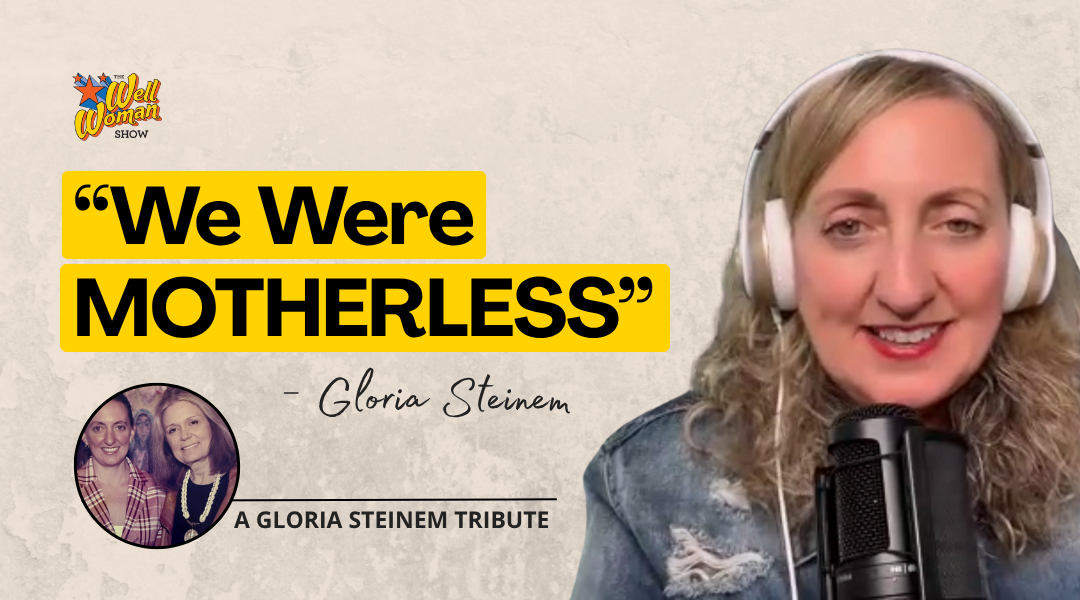
In a solo episode of The Well Woman Show, I reflect on Steinem’s ideas about sisterhood and the role women can play in helping one another feel heard, valued, and supported.
Her words offer an important reminder: we do not have to build self-trust entirely on our own.
What Gloria Steinem Meant by Women Becoming Each Other’s Mothers
Steinem expressed a powerful idea about the women’s movement:
“What the women’s movement has done is to allow women to become each other’s mothers.” - Gloria Steinem
She was describing something deeper than friendship. Many women grow up without consistently receiving the encouragement, affirmation, or emotional support they need.
This isn’t necessarily because the people who raised them didn’t care. The pressures and expectations placed on women can affect their ability to feel powerful and fully supported, too.
Steinem’s idea invites us to consider what becomes possible when women offer one another some of what may have been missing.
This doesn’t mean replacing our mothers or pretending that past experiences didn’t matter. It means recognizing that support, encouragement, and affirmation can continue to shape us throughout our lives.
✨ The Well Woman Principle: Self-trust is how we know and it isn’t always something we can summon by trying harder or telling ourselves to be more confident. Sometimes, we begin to trust ourselves because another person sees something in us that we have trouble seeing on our own.
When someone listens to us with care, takes our ideas seriously, or reflects our strengths back to us, we have an opportunity to reconsider the doubts we may have carried for years.
That doesn’t mean we need someone else’s approval to know our worth. It means that our relationships can help us reconnect with what we already have within us.
For women who are accustomed to being the strong one, the leader, or the person everyone turns to, receiving that kind of support can be just as important as offering it.
We can be capable and still need encouragement. We can lead others and still need a place where we feel supported ourselves.
Self-trust grows when we learn to recognize our own worth and allow others to remind us of it, too.
What Women Supporting Women Looks Like in Everyday Life
The idea of becoming each other’s mothers might sound abstract, but it can take very ordinary forms.
It can be the friend who tells you plainly that your idea is good before you’ve convinced yourself it is. It can be the mentor who believes in your next move before you have the confidence to believe in it yourself.
It can be a group of women who encourage one another to speak up, take up space, and pursue what matters to them.
And it can be a room full of women who come together simply to enjoy one another’s company.
That is part of what inspired Well Woman Drinks, our monthly gathering in New Mexico. There is no agenda to accomplish and no pitch to make. It is an opportunity for women to be together, connect, and share space.
There is something meaningful about creating a place where we don’t have to prove our value before we belong.
✨ The Well Woman Principle: Joy is how we sustain. Women supporting women isn’t only about helping one another through difficult moments. It is also about making room for connection, companionship, and joy.
When so much of life asks us to produce, achieve, care for others, and keep moving, simply being together can feel surprisingly restorative.
We don’t always need to solve a problem or find the perfect advice. Sometimes, it is enough to listen, share a moment, and remind one another that we are not alone.
Community gives us space to be more than what we do for other people. It reminds us that connection itself has value.
Supporting One Another Without Trying to Fix Everything
One of the things I appreciate about Steinem’s idea is that it doesn’t require us to have all the answers.
We don’t have to repair every hurt another woman carries. We can’t change someone else’s past, and we cannot build another person’s confidence for her.
But we can offer encouragement. We can listen without judgment. We can recognize a woman’s strengths and tell her what we see.
We can also allow ourselves to receive that same care.
For women who are used to being the dependable one, accepting support may feel unfamiliar. Yet sisterhood asks us to make room for both giving and receiving.
We don’t have to do everything alone to prove that we are capable.
✨ The Well Woman Principle: Ease is how we lead. When we believe that every challenge is ours to manage alone, even meaningful work can become unnecessarily heavy. Allowing other women to support us is one way to loosen that expectation.
So is creating relationships and communities where encouragement, care, and shared experience are part of how we move through life.
Ease doesn’t mean that everything becomes effortless. It means recognizing that we can approach our lives differently when we don’t expect ourselves to carry everything by ourselves.
We can make room for support, for connection, and for the possibility that we don’t always have to be the strongest person in the room.
A Simple Practice for Women Supporting Women
In the episode, I leave listeners with one small invitation:
Tell one woman in your life something true and good that you see in her.
Not just a compliment about what she is wearing, but something about who she is. Tell her that you admire how she makes people feel welcome, how she approaches a difficult problem, or how she keeps showing up for something that matters to her.
Be specific. Say it out loud.
You may not know how much she needs to hear it. And you don’t have to know the full story of her life for your words to matter.
Then consider another question: Can you let someone do the same for you?
We often underestimate the effect of these small moments of recognition. But they are one way we can help create the kind of relationships in which women feel seen, encouraged, and supported.
We Were Never Meant to Do This Alone
Gloria Steinem’s words remind us that the work of building confidence and self-trust doesn’t have to be a solitary one.
We can offer one another encouragement that helps us move forward.
We can create communities where women have room to speak, lead, and be themselves.
And we can recognize that receiving support is not a failure of independence. It is part of being human.
This is one of the things I hope we continue to practice, in our friendships, in our communities, and in the spaces we create together.
Who is one woman you can encourage this week? And where might you allow yourself to receive a little more support?
Ease, joy, impact, and self-trust were never meant to be solo projects.
Listen to the full episode of The Well Woman Show: “Just Giovanna: Gloria Steinem and the Power of Women Supporting Women.”
Below is the full transcript of the episode.
A good friend of mine recently reminded me of a Gloria Steinem interview, where she said.
“How we know we have something to say is that we're listened to as a child.
How we know we're lovable is that we were loved as a child.”
If those things were absent, it takes a long time to make up for them.
And if we sit for that for a second, it's super powerful, right? Because if you've ever wondered why confidence feels harder for you than it seems, perhaps, for other people, that could be part of the answer.
Welcome back to the Well Woman Show. I'm Giovanna Rossi, and today it's just me and you. No guest, just an idea I can't stop thinking about, and a woman whose words gave language to something a lot of us have felt but never said out loud.
Who is Gloria Steinem
Gloria Steinem spent more than 5 decades as one of the clearest voices in the fight for women's equality; a journalist, an organizer, a co-founder of Ms. Magazine, and for generations of women, a kind of older sister telling us the truth.
She didn't come to that work from an easy place. Her own mother struggled with her mental health for most of Gloria's childhood, and young Gloria became her caretaker long before she became anyone's icon.
That really matters, because it's exactly where today's idea comes from.
"We Were Motherless"
In a clip that's been circling online, Gloria said something that I think is one of the most radical things she really ever put into words.
She said, “How we know we have something to say is that we were listened to as a child. How we know we're lovable is that we were loved as a child.”
And then she went further. She talked about how many women grew up with mothers who were, in her words, “driven a little crazy by a society that wouldn't let them be powerful”.
Not through any fault of their own. And because of that, she said, in some sense.
A lot of us were motherless.
Not literally.
But emotionally, structurally.
Then came the line that I want you to really hear.
“What the women's movement has done is to allow women to become each other's mothers.”
She's not saying the movement gave us new mothers to replace the ones who couldn't show up for us. That's not possible. What happened, happened.
What she's describing is repair. Repair doesn't erase the wound.
It works alongside it.
It says, yes, the gap is real, and you don't have to carry it alone for the rest of your life.
Other women can help close it, steadily, the way real healing happens.
And notice her word choice, allow. Not force, not require. The movement cleared space for women to mother each other on purpose, together, not alone.
Why This Lands Differently Now
And I want to be honest with you, we're recording this not long after the world lost Gloria Steinem.
And so I'm not gonna turn this into a eulogy, she'd probably tell us not to. What she'd want, I think, is for her ideas to keep doing what they've always done: Work.
And this particular idea is doing work in your life right now, whether you've named it or not.
Because here's the thing about we were motherless. It's not really about mothers. It's about the voice inside you that had to learn, late and the hard way, that what you have to say matters. That you are lovable simply because you exist.
Not because you performed your way into it.
And so, if that's you, and for a lot of high-achieving women, it is, Gloria's insight is that you don't have to wait for someone in the past to fix it. You can build that mothering now, sideways, with each other.
What "Becoming Each Other's Mothers" Looks Like Today
So, let's make this practical because ease and impact both live in the specific, not the abstract. Becoming each other's mothers might look like the friend who tells you plainly that your idea is good before you've convinced yourself that it is.
It might be the mentor who believes in your next move before you've built the confidence to believe in it yourself.
The community of women online, in a group chat, in this very podcast audience, who model for each other what it looks like to take up space without apologizing for it.
A room full of women who show up face to face just to be in each other's company. That's actually the whole idea behind Well Woman Drinks, our monthly gathering here in Albuquerque, New Mexico. No agenda, no pitch, just women together in the same room. It sounds simple and it is simple. And it's exactly the kind of sideways mothering Steinem was talking about.
So, this is self-trust in action, right? Not the kind you conjure alone in a vacuum, but the kind that gets built, reflected back to you by other women who see you clearly and say so.
Gloria once put it this way, describing what a movement actually is.
“It's only people moving. One at a time, showing up for each other.”
That's not a metaphor, it's not a mechanism, that's literally how repair happens.
The Challenge
So, here's what I want to leave you with. If you grew up without enough of that early mirroring, without someone consistently reflecting back that your voice mattered and that you were lovable just as you were, that absence is real, and it's not your fault.
And it's not too late.
You don't have to wait for a mother figure to arrive and undo it.
You can be that for another woman today, and you can let other women be that for you, which, if you're used to being the strong one, might be the harder ask.
This week, I want to ask you, challenge you to try one small thing.
Tell a woman in your life specifically and out loud, something true and good you see in her. Not a compliment on her outfit, something about who she is.
That's mothering, sideways.
That's the movement, one person at a time.
Gloria Steinem gave us a lot of language over the decades about power, about voice, about refusing to be a victim of our own stories.
But this idea about becoming each other's mothers might be the most personal gift in all of it.
Because it means none of us has to do this alone. Ease, joy, impact, self-trust.
They were never meant to be solo projects anyway.
So, thanks for spending this time with me. If this episode moved something in you, send it to a woman who needs to hear it. And while you're at it, be the voice that tells her what she has to say matters. Until next time, take care of yourself and take care of each other.